Published by Reputaro | Trustpilot Growth & Reputation Management
Half a star. That is the gap between 3.9 and 4.5 on Trustpilot. In absolute terms, it sounds trivial — the kind of difference a single bad week could create and a good week could reverse. Most business owners, when they see their rating sitting at 3.9, assume they are essentially in the same ballpark as a 4.5-star competitor.
They are not. Not even close.
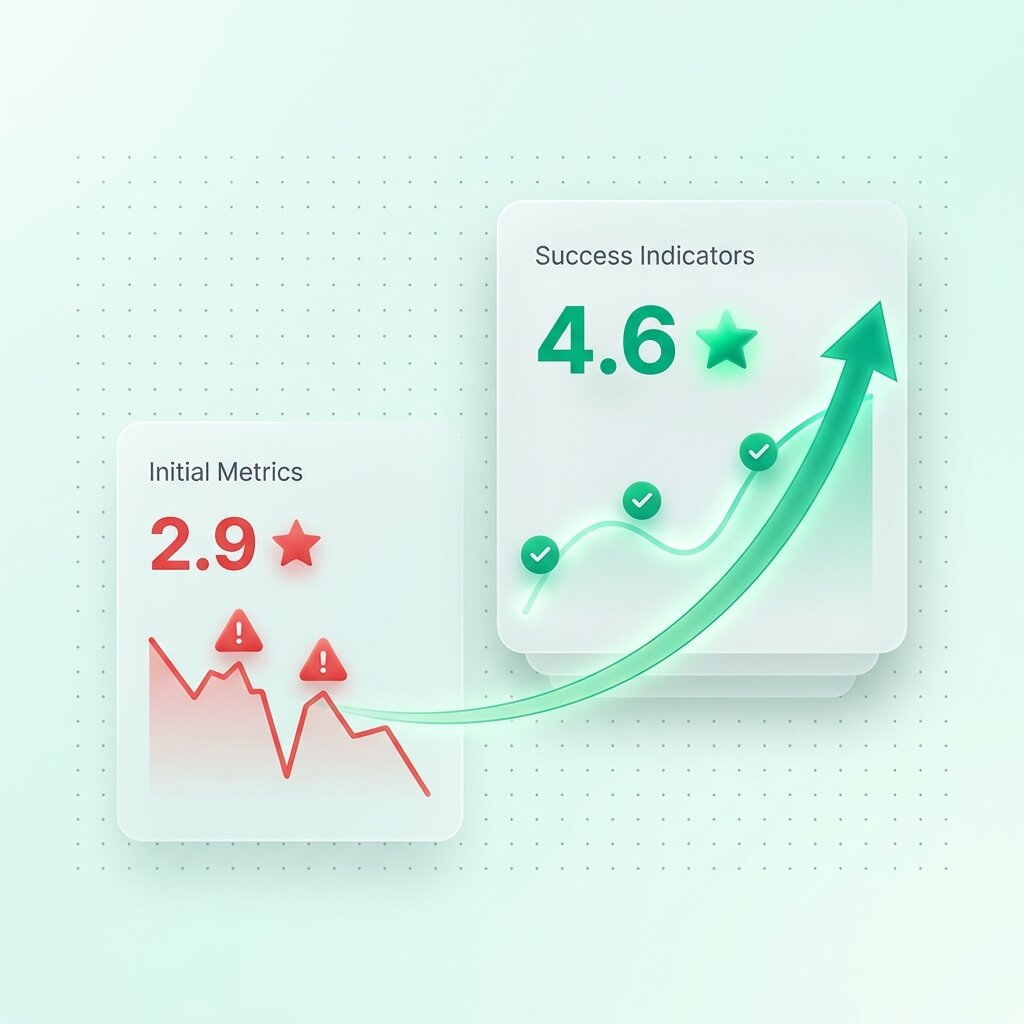
The conversion rate difference between a 3.9-star rating and a 4.5-star rating is not linear. It is not proportional. It is dramatic — and the research that documents it consistently points to figures in the range of 25 to 35 percent better conversion performance for businesses in the Excellent tier versus those sitting just below the 4-star threshold.
Understanding why this gap exists — and why it is so much larger than the mathematical distance between the two scores suggests — is one of the most commercially valuable things a business owner can learn..
Consumer decision-making under uncertainty follows patterns that are well-documented in behavioural psychology. When a buyer is evaluating an unfamiliar business, they are not making a rational calculation of expected value. They are managing perceived risk.
The question running through a buyer's mind is not "how likely is it that this product is good?" It is "how badly will I feel if this goes wrong?" Loss aversion — the documented tendency to weight potential losses more heavily than equivalent gains — means that buyers are disproportionately sensitive to signals of risk, and disproportionately reassured by signals of safety.
Star ratings function as a rapid risk signal. And the human brain does not process them on a linear scale.
A 3.9-star rating triggers a specific internal response: "this is not quite good enough." It sits just below the psychological threshold of 4 stars, and that position is interpreted not as "almost excellent" but as "didn't quite make it." The implication — entirely subconscious for most buyers — is that something is preventing this business from achieving a 4-star rating. What is it? The buyer doesn't know. But they feel the uncertainty.
A 4.5-star rating triggers a completely different response: "this is trusted by most people who use it." The "Excellent" label reinforces this. The colour coding reinforces this. The star display reinforces this. The buyer's risk anxiety is substantially reduced, and the cognitive energy that would have gone into researching alternatives or adding items to a wishlist to "think about later" is freed up for conversion.
Spiegel Research Centre, in one of the most cited studies on review ratings and purchasing behaviour, found that the purchase likelihood for a product with five reviews was 270 percent higher than for a product with no reviews — but the relationship between rating level and conversion is equally striking.
Products and services rated between 4.0 and 4.7 stars convert at significantly higher rates than those below 4.0. Critically, the study found that perfect 5.0 ratings actually convert slightly worse than 4.5 to 4.7 ratings — because buyers find perfection suspicious. The sweet spot for maximum conversion is not the highest possible rating. It is the "Excellent" zone of 4.5 to 4.7 stars.
Northwestern University's Spiegel Research found that even a single rating — as low as one review — increases purchase likelihood by 65 percent. But the conversion impact of the rating level itself compounds on top of that baseline effect.
Additional research from the Baymard Institute into e-commerce conversion found that trust signals — including third-party review badges and ratings — are among the top five factors influencing whether a visitor completes a purchase or abandons.
The conversion improvement from moving from 3.9 to 4.5 stars is not concentrated in one place. It appears across every touchpoint where your rating is visible.
Website landing pages: Visitors who see an Excellent badge spend more time on page, scroll further, and initiate checkout or enquiry flows at higher rates than those seeing a Good or Average badge. This effect is strongest on pricing pages, where purchase intent is highest and anxiety is most acute.
Google Ads: Seller rating extensions showing 4.5 stars generate click-through rates 10 to 17 percent above the same ads without stars. But the post-click conversion rate also improves because the landing page the visitor arrives at confirms the trust signal the ad established.
Email marketing: Emails that include a Trustpilot badge showing 4.5 stars in the signature or header consistently outperform those showing lower ratings or no badge in A/B tests across e-commerce and SaaS senders.
Comparison and review sites: On platforms where your Trustpilot score is pulled in as a data point — Google Shopping, insurance aggregators, software comparison sites — appearing in the Excellent tier changes your position in filtered results and your prominence in category listings.
Word of mouth: This one is harder to measure but real. Customers who chose you partly because of your Excellent rating are more likely to recommend you to others — because the rating validated their choice and they feel comfortable passing that validation on.
The gap between 3.9 and 4.5 stars feels large in impact but is often smaller in execution than businesses expect. The number of new five-star reviews required depends on your current review count — but for businesses with under 200 reviews, moving half a star typically requires between 30 and 80 new five-star submissions.
At a review acquisition cost of £15 per review, that is a £450 to £1,200 investment to unlock a 25 to 35 percent conversion rate improvement across every channel where your rating is visible.
For a business converting £30,000 per month in revenue, a 30 percent improvement means £9,000 in additional monthly revenue. The return on that investment is achieved within the first month and continues indefinitely.
The rating is not a vanity metric. It is a revenue lever — and half a star in the right direction is worth more than most businesses spend on a full month of paid advertising.
If your rating is currently below 4.5 stars, the most important calculation you can run is how many five-star reviews it would take to reach the Excellent threshold from your current position.
Our Rating Calculator at Reputaro gives you that number precisely — based on your actual current rating and review count, with no estimation required.
Once you have that number, the path to Excellent is a planning exercise, not a mystery.
Calculate exactly how many reviews you need to reach 4.5★ at reputaro.io/calculator