Published by Reputaro | Trustpilot Growth & Reputation Management
When Amazon first started showing customer reviews in 1995, it was controversial. Publishers and retailers worried that negative reviews would kill sales. They pushed back. Jeff Bezos held the line, arguing that helping customers make better decisions — even if that meant surfacing negative feedback — would build long-term trust in the platform.
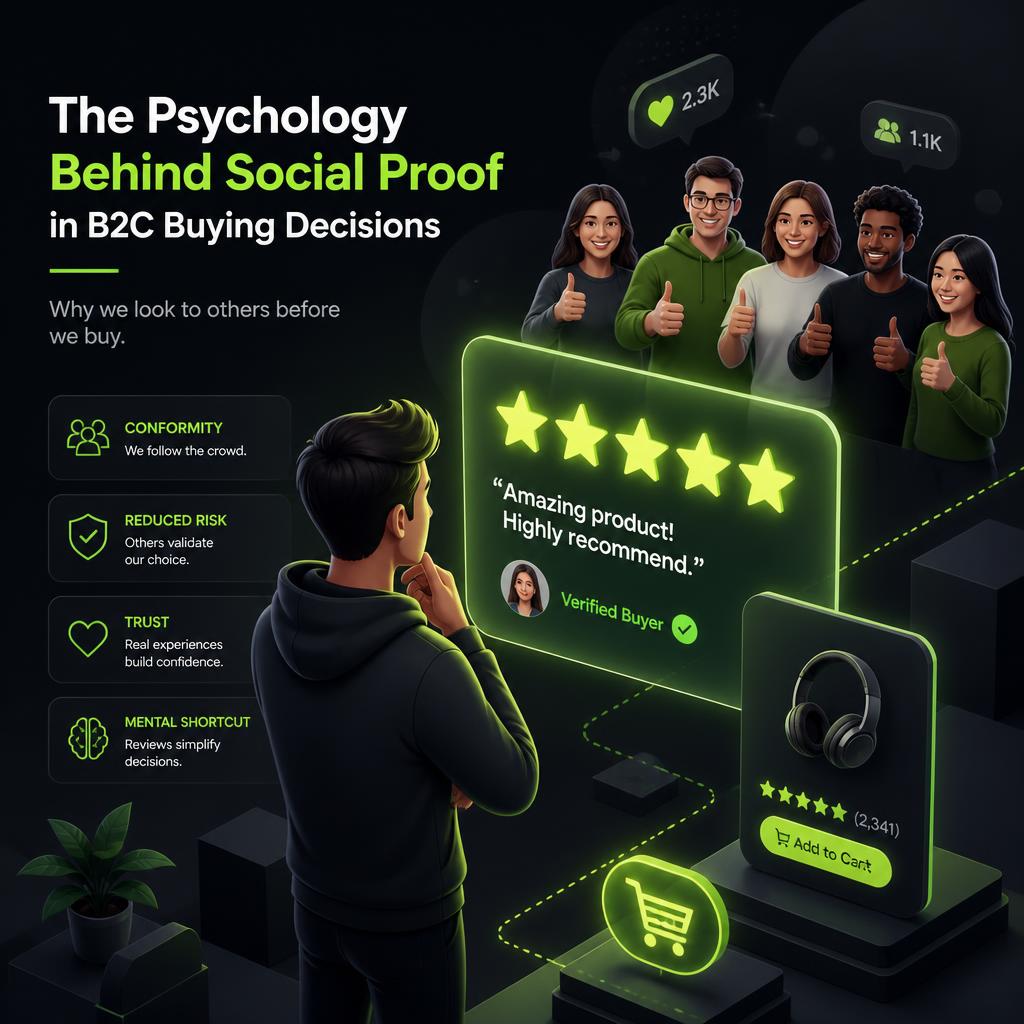
He was right. And the mechanism that made him right — the deep psychological effect of social proof on purchasing behaviour — is now one of the most thoroughly documented phenomena in consumer psychology.
Understanding why social proof works is not just academically interesting. For any business that sells to consumers, it is practically essential. Because when you understand the psychology, you understand why your Trustpilot rating is not a marketing asset — it is a fundamental driver of whether people buy from you or not.
The term "social proof" was coined by psychologist Robert Cialdini in his 1984 book Influence, where he identified it as one of six core principles of persuasion. His definition is precise: social proof is the tendency to look to the behaviour and opinions of others to determine the correct course of action, particularly in situations of uncertainty.
The key phrase is "situations of uncertainty." When a consumer is considering purchasing from a brand they've never used before, they are in a state of genuine uncertainty. They don't know if the product will be as described, if the service will be reliable, if their money is safe, or if they will be treated well if something goes wrong.
In that state, the brain reaches for shortcuts. And the most powerful shortcut available is: what did other people like me do, and how did it go for them?
This is not a conscious, deliberate reasoning process. It is a deeply embedded cognitive heuristic — a mental pattern that evolved to help humans navigate uncertainty by leveraging collective experience. Reviews trigger this heuristic automatically. The brain sees "4.7 stars, 2,400 reviews" and immediately processes: thousands of people bought this, most of them had a good experience, therefore the risk of buying is low.
One of the most counterintuitive findings in social proof research is that the volume of reviews often matters more than the content of individual reviews. A business with 800 reviews averaging 4.2 stars frequently outconverts a business with 12 reviews averaging 4.8 stars — even though the average rating is lower.
The reason is the conformity effect. A large number of reviews signals consensus. The brain interprets consensus as accuracy — if 800 independent people arrived at broadly the same conclusion about this business, the probability of that conclusion being correct is high. Twelve reviews, however positive, represent a small sample. The brain is appropriately sceptical.
This is why review volume building is not just about raising your average score. It is about reaching the threshold at which your review count itself becomes a trust signal. That threshold varies by industry and category, but in most consumer markets, 100 reviews is where credibility starts to feel real, 250 is where consensus begins to register, and 500+ is where volume itself becomes a competitive differentiator.
Social proof has a time dimension that is frequently underestimated. A review from three years ago carries significantly less psychological weight than one from last week — even if the content is identical and the rating is the same.
The reason is that consumers are aware that businesses change. A company that had great reviews in 2021 might have changed ownership, scaled poorly, or had service deteriorate since then. Recent reviews are evidence of the current state of the business. Older reviews are evidence of how it used to be.
This is what makes review recency — consistently receiving new reviews over time — such a critical metric. It is not just about Trustpilot's algorithm weighting recent reviews more heavily. It is about the basic psychology of the customers reading your profile. A profile with its most recent review dated three months ago triggers an immediate question: why has no one reviewed this recently? Has something changed? Are customers no longer buying here?
The answer to those questions might be entirely innocent. But the doubt they create is not.
The practical conclusion of everything social proof research tells us is that effective reputation management is a system, not a campaign. A one-time push to collect reviews addresses none of the ongoing mechanisms — conformity, recency, verified credibility — that make social proof powerful over the long term.
A business that consistently collects reviews across its customer base, maintains review recency, responds professionally to negative feedback, and monitors its profile health has built a structural trust advantage that compounds over time. Each new review adds to the conformity signal. Each professional response demonstrates the authority of a business that takes accountability seriously. Each verified review adds a layer of credibility that no marketing copy can substitute.
This is what reputation management, done properly, actually is. Not a cosmetic exercise in damage control — but a fundamental driver of commercial performance, built on one of the deepest mechanisms in human psychology.
Start building your social proof foundation today — run a free Trustpilot Audit at reputaro.io/audit