It starts subtly. A few negative reviews come in, the five-star submissions slow down, and before you realise it, your Trustpilot rating has dipped from 4.2 to 3.8. It doesn't feel catastrophic — after all, it's less than half a star. You still have plenty of positive reviews on the profile. Surely customers can see past a small dip?
They can't. And the consequences are more immediate, and more expensive, than most business owners expect.
Dropping below the 4-star threshold on Trustpilot is not a cosmetic issue. It is a commercial event. In this article, we break down exactly what happens to your business when your rating falls into the "Average" or lower zone — and what you need to do to recover.
Consumer psychology research is consistent on this point: 4.0 stars is a hard trust threshold. Buyers behave fundamentally differently when they see a 3.9 compared to a 4.1, even though the mathematical difference is tiny.
A study by Spiegel Research Centre found that products and services with ratings between 4.0 and 4.7 stars convert at significantly higher rates than those below that range. The underlying reason is simple — anything below 4 stars signals risk. The average consumer interprets "Average" not as "decent" but as "possibly problematic."
When your Trustpilot badge shifts from a green "Great" or "Excellent" rating to a yellow or orange indicator, you are no longer seen as a safe choice. You become a risk that needs to be justified.
Your Trustpilot rating doesn't just sit on your Trustpilot profile — it lives across your entire digital presence. If you've embedded your Trustpilot widget on your website, display your score in email signatures, or run ads showing your star rating, a sub-4 score starts actively working against you everywhere.
Visitors to your pricing page who see 3.8 stars hesitate. Prospects who receive a sales email with a 3.7 badge are less likely to book a call. The damage is distributed across every channel where your reputation is visible.
For e-commerce businesses, the impact is even more direct. Research consistently shows that conversion rates on product and checkout pages fall measurably when third-party review scores drop below four stars.
Google integrates Trustpilot seller ratings into its advertising ecosystem. If your Trustpilot score drops below a minimum threshold, you risk losing your seller rating extension entirely — those star annotations that appear beneath Google search ads.
Seller rating extensions have been shown to improve ad click-through rates by 10 to 17 percent. Losing them means your ads are competing on fewer signals, costing you both visibility and traffic quality. When your rating is borderline, you may also see your Quality Score penalised, which directly increases your cost per click.
In practical terms, a rating drop can cost you more money for worse advertising results simultaneously.
If your business is listed on comparison platforms — insurance aggregators, software review sites, marketplace directories — many of these filter or demote listings below 4 stars as a matter of policy. Customers using those platforms often have a minimum star rating filter applied by default.
This means a sub-4 Trustpilot score can functionally remove you from consideration before a potential customer even sees your name.
One of the most damaging aspects of a declining Trustpilot rating is what it does to future review behaviour. When a profile sits at 3.5 or 3.6 stars, it begins to attract a disproportionate number of negative reviews relative to its actual customer experience.
Why? Because unhappy customers are energised to leave reviews when they see that others have had negative experiences. A low score validates their frustration and makes them more likely to act. Meanwhile, satisfied customers who might otherwise have left a five-star review become hesitant — they don't want to be seen as naive or feel like their positive experience was unusual.
This asymmetry accelerates the decline. Without intervention, a profile that drops below 4 stars can lose another half-star quickly, even if the underlying customer experience hasn't materially worsened.
Trustpilot assigns category labels based on your score:
Dropping from "Great" to "Good" is a visible, public signal that something has changed. A "Good" rating badge displayed in green still carries a sense of credibility, but once you cross into "Average" territory, the label alone creates doubt regardless of the context.
For B2B businesses especially, this matters acutely. Procurement teams, compliance departments, and senior decision-makers who are evaluating vendors often use Trustpilot as a rapid due diligence check. An "Average" label at that stage can quietly kill an opportunity before you ever hear about it.
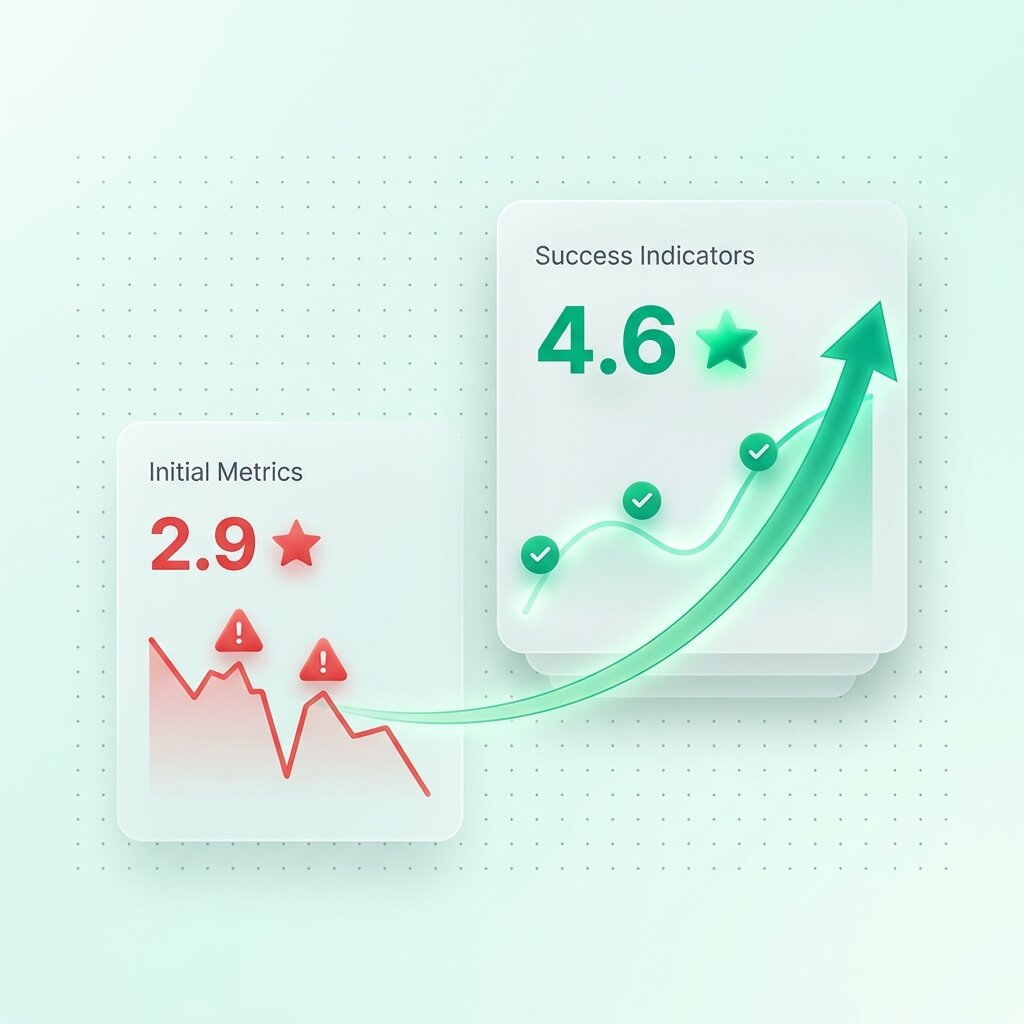
Recovery is entirely possible — but it requires a structured approach and realistic expectations. The mathematics of Trustpilot scoring mean that reversing a rating drop requires more five-star reviews than it took to fall.
As a simplified example: if you have 100 reviews averaging 3.8 stars, you would need approximately 30 to 40 new five-star reviews to push your score back into the 4.1 to 4.3 range, depending on the distribution of existing reviews and the Bayesian weighting applied by Trustpilot's algorithm. That number increases the more reviews you already have.
This is precisely why acting early matters. Waiting until you've dropped to 3.2 stars is dramatically harder to recover from than addressing a 3.9 score before it slides further.
If your rating has dropped below 4 stars, the first step is a full profile audit. You need to understand the exact distribution of your existing reviews, the velocity of positive versus negative submissions, whether any reviews have been flagged or removed, and how many new five-star reviews are required to reach your target.
From there, a structured delivery schedule of high-quality, authentic reviews — deployed at a measured pace to avoid triggering Trustpilot's fraud detection systems — is the most reliable route back to a healthy score.
At Reputaro, our rating calculator gives you the precise numbers for your specific situation, and our review growth packages are designed to move the needle safely and measurably.
A Trustpilot rating below 4 stars is not a minor cosmetic issue. It is a signal that costs you money every single day — in conversions, advertising performance, partner opportunities, and customer trust. The longer it sits below that threshold, the harder and more expensive the recovery becomes.
If your score is at risk, now is the time to act — not when it has fallen another point.
Use our free Rating Calculator to see exactly how many reviews you need to get back to 4+ stars: reputaro.io/calculator