Published by Reputaro | Trustpilot Growth & Reputation Management
Most businesses treat their Google Ads account and their Trustpilot profile as two entirely separate concerns. One is handled by the marketing team, the other is left to customer service. The budget for one is carefully tracked; the other is an afterthought.
This is a costly mistake.
Your Trustpilot rating directly influences how your Google Ads perform — affecting your click-through rate, your Quality Score, your cost per click, and ultimately your cost per acquisition. The connection between review reputation and paid search performance is well-documented, measurable, and in most cases, completely overlooked.
Here is exactly how it works.
Google operates a feature called Seller Ratings — star annotations that appear directly beneath your search ads, showing your aggregate review score alongside the number of reviews collected. These stars are pulled from a range of approved review platforms, and Trustpilot is one of Google's primary data sources.
When your Trustpilot profile meets Google's minimum threshold — currently a minimum of 100 reviews and a score of 3.5 stars or above — your seller rating becomes eligible to appear automatically in your search ads, your Shopping ads, and your Performance Max campaigns.
The impact of this annotation is substantial. Google's own data indicates that seller ratings improve ad click-through rates by an average of 10 percent. Independent studies and agency reports put the figure higher — between 10 and 17 percent depending on the industry and competitive landscape.
That improvement in CTR, compounded over a full month of ad spend, represents a significant volume of additional traffic that you are either capturing or leaving for competitors.
If your Trustpilot score drops below 3.5 stars, or if you haven't accumulated the minimum review count, your seller rating annotation disappears from your ads entirely. Your ads run without stars. They look identical to a business with no reviews at all.
In competitive search auctions — particularly in e-commerce, financial services, software, and professional services — a significant proportion of your competitors will be showing seller ratings. Your starless ad sits alongside annotated competitors, and the contrast is not in your favour.
Buyers scanning search results use visual cues to make rapid assessments. A row of gold stars communicates legitimacy, trust, and social proof in under a second. An ad without stars communicates nothing on those dimensions. The click goes elsewhere.
The connection between Trustpilot and Google Ads extends beyond the ad itself into what happens after the click. If you are embedding your Trustpilot widget on landing pages — showing your live star rating and recent reviews — then a declining score creates a trust gap that undermines your entire paid acquisition funnel.
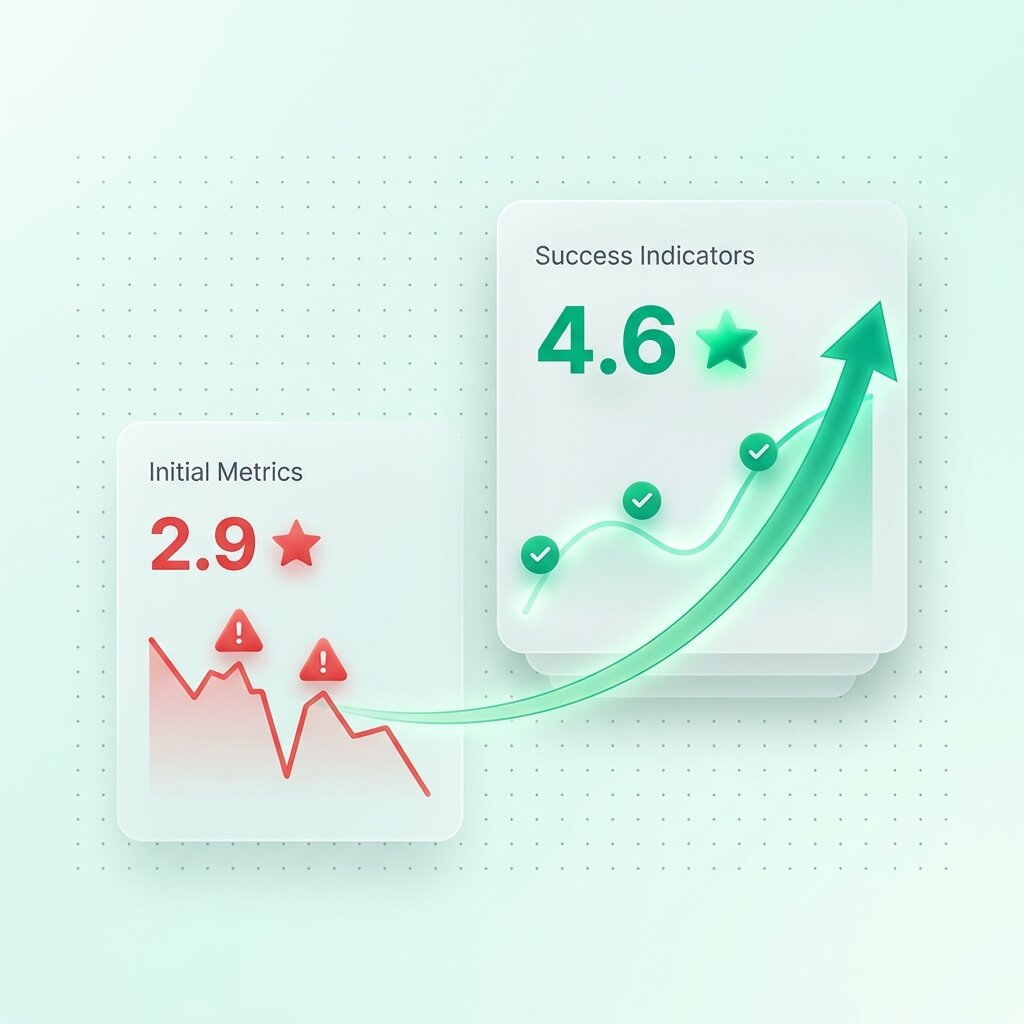
A visitor who clicked an ad showing 4.6 stars and arrives on a landing page showing the same 4.6 stars experiences confirmation and comfort. A visitor who clicked an ad showing seller rating stars (from an older, higher score) and arrives on a page now showing 3.8 stars experiences a jarring disconnect. Their trust erodes before they've read a single word of your copy.
This mismatch — between what ads promise and what landing pages deliver — is one of the most expensive and least-discussed conversion rate killers in paid search.
There is a less obvious way Trustpilot affects your Google Ads that many businesses don't discover until it's too late. When a competitor or disgruntled party runs a sustained negative review campaign against your profile, your star rating can drop quickly enough to affect your brand search results.
People who search your brand name directly — the warmest possible traffic, people who already know you — will see your Trustpilot score displayed in your Google knowledge panel and in your own brand ads. If that score has deteriorated, you are losing conversion rate on your most valuable traffic: the people who were already looking for you specifically.
Let's model this concretely. Assume a business is spending £15,000 per month on Google Ads, generating 15,000 clicks at an average CPC of £1.00, converting at 2.8 percent, with an average order value of £180. That's 420 sales, generating £75,600 in monthly revenue.
If improving their Trustpilot score from 3.6 stars to 4.5 stars:
Reinstates seller rating extensions, improving CTR by 12 percent — adding 1,800 clicks per month at no extra cost
Improves landing page conversion rate from 2.8 to 3.4 percent
The combined effect: approximately 90 additional sales per month — £16,200 in additional revenue from the same ad spend
The cost of generating those 90 additional conversions through reviews rather than additional ad spend is a fraction of what it would cost to buy that traffic at £1.00 per click.
The first step is understanding where your Trustpilot profile currently stands and what it would take to reach the 4.5-star threshold where seller ratings perform at their strongest. A structured review growth campaign, deployed at a pace that keeps Trustpilot's authenticity systems satisfied, is the most reliable route.
The second step is ensuring your Trustpilot widget is embedded and live on your highest-traffic landing pages — so the score that attracts clicks also supports conversions.
At Reputaro, this is precisely what our review growth packages are designed to deliver — measurable rating improvement that flows directly into better paid search performance.
Ready to see where your profile stands? Run a free Trustpilot Audit at reputaro.io/audit